
- IPL T20Match odds · toss · 6 / 10 / 15 / 20 over sessions
- India T20IPlayer runs · fancy over lines
- India ODI10-over and 50-over session runs
- India TestMatch odds · innings runs · fall of wicket
- Toss cardSettles before ball one
- Player runsOpening pair · number three
FairPlay Cricket — Trusted Session Runs, Fancy Lines and 60 Match Markets on One Screen
Get FairPlay Cricket ID in 90 Seconds
FairPlay Cricket Sign-In: Fast Route to the Match Card
Three boxes stand between you and the cricket list. FairPlay asks for the ID it issued you (a username, not your mobile number) and the password set at sign-up. After that the sportsbook opens on the dashboard, and Cricket sits in the sport row with the other four tabs.
Type the username exactly as issued. A stray space at the end, often added by phone autocomplete, is the classic reason a correct password gets rejected.
First visit? The FairPlay ID comes out of sign-up, so until that step is done the top field on this card has nothing to hold.
FairPlay Cricket Markets: 60 Live Lines on Every Match Card
Open any fixture on FairPlay and the screen splits into blocks. Match odds sit at the top, the toss card sits next to it before play starts, and below them the session and fancy ladders stack innings by innings. Sixty markets sounds like a wall of numbers. It is less chaotic than that, because FairPlay groups them into families and every family settles on one thing that happens on the field.
| Family | Settles on | Where it sits | Reads as |
|---|---|---|---|
| Match odds | Who wins the match | Top block | Back and lay prices for each side |
| Toss | Which captain calls right | Beside match odds, pre-match only | Two prices, closes at the toss |
| Session runs | Team score at an over mark | Session ladder, per innings | No and Yes numbers with a rate |
| Player runs | One batter's final score | Fancy block | No and Yes around a run figure |
| Fancy runs | A narrower event: an over, a partnership, a fall of wicket | Fancy block, below sessions | Same No / Yes ladder |
On FairPlay match odds, two columns per team. Left column backs that side to win. Right column lays it, meaning you win if that team does not, and the slip states the maximum you could lose on the lay before anything is matched. On a fast IPL chase that pre-computed figure saves real time.
Toss is the smallest block and the first to close. It closes before the coin goes up, so if you want it, open the fixture early. Everything else on the card stays open far longer.
Sessions and fancy lines are where most of the 60 live. A T20 innings alone throws up several over marks, two openers, a number three and a handful of partnership lines, and FairPlay repeats the set for the second innings. Across a full match the count adds up quickly (it is probably the only reason 60 does not feel like padding).
Every one of these runs on the same wallet. FairPlay groups the whole sportsbook into 12 market types; cricket simply uses more of them per fixture then any other sport.
FairPlay Match Odds: A Real Back and Lay Example
Numbers help here. Suppose the FairPlay match odds block shows the chasing side at 1.85 to back and 1.87 to lay. Back them with ₹200 and the slip shows a profit of ₹170 if they win; lose, and it is the ₹200 stake that goes. Lay them at 1.87 for ₹200 instead and the arithmetic flips. You collect ₹200 if they lose, and your liability if they win is ₹174, which FairPlay holds from the wallet the moment the lay is matched.
That held amount confuses people. The balance drops by the liability, not the stake, and it comes back (plus or minus the result) once the match settles. Two positions on the same match, one back and one lay, can offset each other, and the bet slip shows the combined figure before you confirm the second one. Prices in this example are made up for the maths; live ones move with every over.
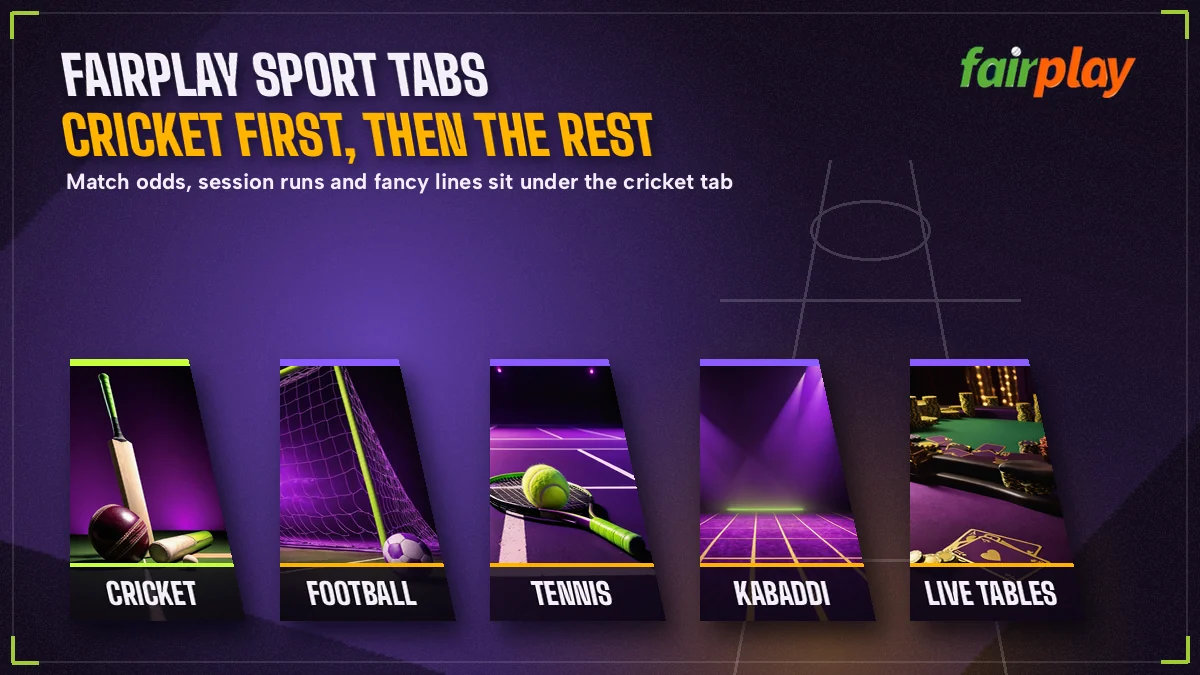
FairPlay Football and the Other Live Sport Tabs
Tap the next tab along from Cricket and FairPlay football loads, with the login, wallet and bet slip left exactly as they were. Only the fixture list changes. With 8 sports running live across the site, there is normally something to open on a day when no cricket is scheduled. The markets differ from cricket, of course, but the bet slip and the open bets list behave identically. For slots, live tables and Aviator, the FairPlay games lobby covers all 14 game tabs.
FairPlay Session Runs and Fancy Lines: Real Examples, Read Line by Line
A FairPlay session line asks one question: how many runs will this team have at a set over? Two numbers answer it. The lower one is the No figure, the higher one is Yes, and between them sits a small gap that the sportsbook keeps. Back No and you want the score to finish below the No number. Back Yes and you want it at or above the Yes number.
Watch the size of that gap, too. On a calm over it is usually one or two runs. Straight after a wicket, or when a big hitter walks in, FairPlay can widen it for a few balls while the price settles, and a line that read No 78 / Yes 80 might briefly show No 76 / Yes 80. Nothing is broken when that happens. Waiting an over for the gap to close back up is often the smarter tap, and the ladder will still be there.
Below are sample ladders in the format FairPlay shows. The numbers are illustrative, not live prices.
6 Over Runs, first innings
No 48Yes 50
rate 100 / 100
10 Over Runs, first innings
No 78Yes 80
rate 100 / 100
Opener runs
No 24Yes 25
rate 100 / 100
Fall of 1st wicket runs
No 30Yes 32
rate 90 / 110
- No
- The lower figure. Backing it on FairPlay wins if the final number stays under it.
- Yes
- The higher figure. Wins when the number reaches it or goes past.
- Rate
- 100 means even money: stake ₹200, win ₹200. Anything off 100 changes the payout, and the slip shows it before you confirm.
- Suspended
- The line greys out while the ball is live, after a wicket or a boundary, then reopens with fresh numbers.
- Settled
- Once the over mark passes, FairPlay closes the line and the result lands in your bet history.
Worked example on the FairPlay 10-over line. Say the ladder reads No 78 / Yes 80 at rate 100, and you back Yes with ₹200. The team reaches 83 after ten overs. Yes has been cleared, so ₹200 profit goes to the wallet with your stake. Had they finished on 76, the ₹200 is gone. And 78 or 79? Both sides lose there, which is the gap doing its job.
That is the theory. In practice the ladder moves every ball, and it jumps hard on a wicket. Tap Yes 80 a second too late and the the slip will come back with Yes 84, or with a suspended message, because the line refreshed while your thumb was moving. FairPlay does not fill a stale number. It asks you to accept the new one or cancel, which is irritating on a fast chase but it's the only fair way to run it.
FairPlay Session Marks by Format: T20, ODI and Test, Live
Session marks follow the length of the game. On a T20 or IPL card, FairPlay session lines typically sit at the 6, 10, 15 and 20 over marks, so the powerplay line is the first to settle, roughly 25 minutes after the start. One-day internationals stretch the ladder out: 10 overs, then further marks through to 50, with far more time between each settlement. Tests are different again, and slower. Lines there tend to follow innings totals and fall of wicket rather than a neat over count.
Why it matters in practice: a T20 session can settle before you have finished your tea, while an ODI line might stay open for well over an hour. Stake sizes that feel fine on a quick line can sit tied up in the wallet for a long while on a slow one. Check the over mark in the line name before you tap, and the open bets list will show exactly which lines are still waiting on a result.
Fancy lines follow the same No / Yes grammar, just on smaller events. Player runs track one batter; fall-of-wicket lines ask what the score will be when a partnership breaks; over lines settle on the runs in a single named over. A few of them run on rates other than 100, like the 90 / 110 example above, where No pays less than stake and Yes pays more. Read the rate before the number, every time.
Take that 90 / 110 fall-of-wicket line with a ₹200 stake. Backing No 30 on FairPlay pays ₹180 if the first wicket falls with the score under 30. Backing Yes 32 pays ₹220 if the partnership reaches 32 or more. Lose either and the loss is the ₹200 stake, not more. The uneven rate is the sportsbook saying one side is likelier than the other, and the payout shrinks or grows to match. A quick sanity check: stake times rate, divided by 100, is your profit. If the slip shows anything else, the line moved and you should read it again before confirming.
IPL FairPlay Match Nights: Quick Taps From Login to Bet Slip
IPL FairPlay traffic peaks in the half hour before the first ball, which is exactly when a slow login hurts. The fastest route is the 18 MB app with its 5-tap login, but the browser address works the same way and uses the same FairPlay ID. Here is the order of taps on a match night, from a cold start.
- Open FairPlay and sign in. ID and password, then the login button. First time on a new phone, allow about 90 seconds for the full sign-in.
- Tap Cricket in the sport row. IPL fixtures and India series games both show in the cricket list, each with its own card.
- Tap the fixture. The 60-market card opens with match odds on top. Toss is still there if the coin has not gone up.
- Pick a line, pick No or Yes (or back / lay on match odds). A bet slip slides up with the price already filled.
- Enter rupees, read the figure, then confirm. FairPlay prints what the bet returns (or what a lay could cost) beside your chosen price, and nothing is placed until you press confirm.
- Watch the open bets list, not the ladder. Your matched price is locked there even as the session numbers keep moving.
A small habit that saves grief: open the fixture during the anthem, not after the first over. Sessions for the six-over mark are already moving by then and the toss card is long gone. If a FairPlay welcome offer is running, the FairPlay coupon code page lists the 5 codes; add one at deposit, before the match starts, since codes do not attach to a bet already placed.
Where do finished bets go? On FairPlay, open bets and settled bets live under separate dashboard tabs. A session line moves from one to the other as soon as its over mark passes; match odds wait for the final ball. Each settled row shows the line name, your side, the stake, the rate or price, and the amount credited or taken. When something looks wrong, a screenshot of that row is what the support desk will ask for first, so grab it before you message them. It speeds the reply up more than any explanation does.
FairPlay Cricket Errors: Quick Fixes for Five Common Stops
Invalid ID or password
A ten-digit phone number in box one is the usual culprit. FairPlay expects the issued username there. Still failing? Reset takes 4 taps, an OTP and about 2 minutes.
Address will not load
A spinning page or a provider notice means that address got blocked. Open the 18 MB app instead, or pick up another FairPlay mirror address from Telegram; your ID and wallet come along unchanged.
Odds changed on the slip
The line moved while you tapped. Accept the new price or cancel. On a wicket ball, wait for the ladder to reopen first.
Market suspended
Normal between balls on sessions and fancy lines. It clears on its own, usually within seconds.
Balance not showing after deposit
Refresh the dashboard once, then message the desk. First replies come in about 3 minutes on chat, Telegram, email or call-back.
One composite case from the desk: a regular on IPL nights typed his phone number into the ID box three evenings in a row and got the same red error each time, then assumed the account was locked. It wasn't. The username sat in his welcome message the whole time, and he was on the match card inside a minute once he used it.
FairPlay Cricket on Desktop and App: Same Fast Card, Two Layouts
Wide screens get three columns on FairPlay: sports, the 60-line match card, and the slip, all visible during a chase. The app folds that into the 6 dashboard tabs along the bottom, and the slip rises from below when you tap a price. Nothing about the markets changes between the two. Same 60 lines, same ID, same balance, and a bet placed on one shows up in open bets on the other a moment later.
Which is better for IPL FairPlay nights? Hard to say; it depends on the room. The desktop layout is easier for watching several session ladders at once. The app is quicker to open when the match has already started and you are away from a desk, and its 5-tap login beats typing the ID into a browser on a small screen. Plenty of regulars run both, with the laptop for the first innings and the phone once they leave the house, and it makes no diffrence to the wallet.
After the match, winnings sit in the same FairPlay wallet as everything else. UPI payouts clear in about 45 minutes, bank transfers in 2 hours, and the minimum withdrawal is ₹500; the FairPlay withdrawal time page breaks down each method. And if you are wondering whether an Indian account can play at all, the FairPlay rules for Indian players covers 7 states individually.
- fairplay cricket
- ipl fairplay
- fairplay football
- fairplay cricket id
- fairplay cricket betting
- fairplay session
- fairplay cricket betting id
- fairplay fancy lines
- fairplay sports
Related FairPlay Pages: Best Next Stops After Cricket
FairPlay Cricket, IPL FairPlay and FairPlay Football: Verified Search Notes
People reach this page with a handful of searches. FairPlay cricket is the main one, and it points at the Cricket tab with its 60 markets per match.
Nobody at FairPlay issues a cricket-only account. Type the username you already use for slots or teen patti into the FairPlay cricket lobby and the match odds load against that same wallet, so a Test-match stake and an aviator round draw from one balance and settle into one balance.
FairPlay cricket searches and where each one lands
| Search | Lands on |
|---|---|
| fairplay cricket | Cricket tab, full match card |
| ipl fairplay | IPL fixtures inside the cricket list |
| fairplay football | Football tab, next to Cricket |
| fairplay session | Session ladder, per innings and over mark |
- IPL FairPlay nights: open the fixture early so the toss card is still up.
- FairPlay football uses the same login, same balance and same bet slip.
- A fairplay cricket betting id search ends at the 4-field sign-up form, then straight back on this match card.
Across all four tabs above, FairPlay asks for the same two credentials, and a session ladder on an IPL night reads exactly like one on an India ODI.
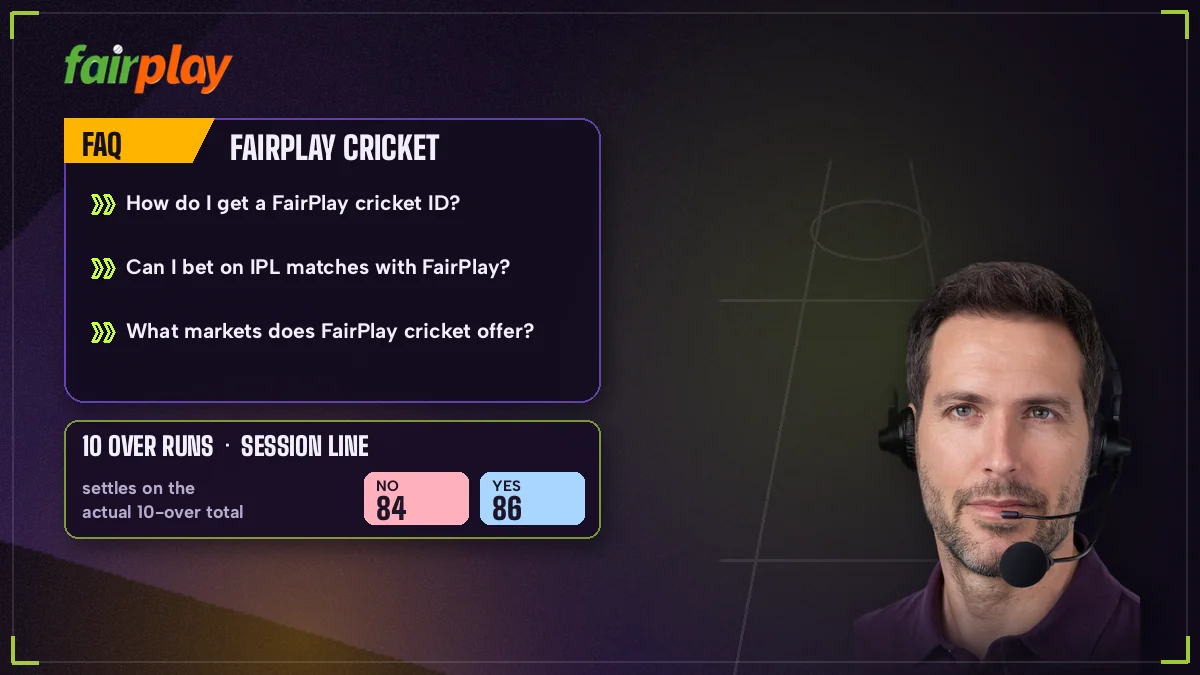
FairPlay Cricket FAQ: Quick Answers Before the First Over
How do I get a FairPlay cricket ID?
Your cricket ID is simply the FairPlay username. There is no cricket-only account, so the four-box sign-up is the only step, and the first login after it runs about 90 seconds. Tap Cricket once you are in; the same username also reaches football, Aviator and the 40 live tables.
Can I bet on IPL matches with FairPlay?
Yes. During the season every IPL game gets its own FairPlay card carrying all 60 lines, from the toss through six-over sessions to opener runs. Anyone after the toss should open that card early, since it shuts before ball one; the other lines stay up well into the innings.
What markets does FairPlay cricket betting offer?
Sixty on a single FairPlay fixture, split across five blocks. Two close early or late: the toss before ball one, match odds at the finish. The other three (session runs, player runs, fancy lines) settle mid-game on over marks, one batter's score or a partnership breaking, so a card keeps paying out while play goes on.
Is FairPlay football on the same account as cricket?
Yes, football is one of the five FairPlay sport tabs and uses the same ID, password and wallet as cricket. Tap Football in the sport row after signing in. The markets are built for football rather than cricket, but the bet slip, open bets list and settlement work identically.
What is a FairPlay session in cricket?
A FairPlay session is a line on a team's total at a fixed over, such as 6 or 10 overs. It shows a No figure and a higher Yes figure with a rate. No wins below the lower figure, Yes wins at or above the higher one, and the line settles when that over ends.